
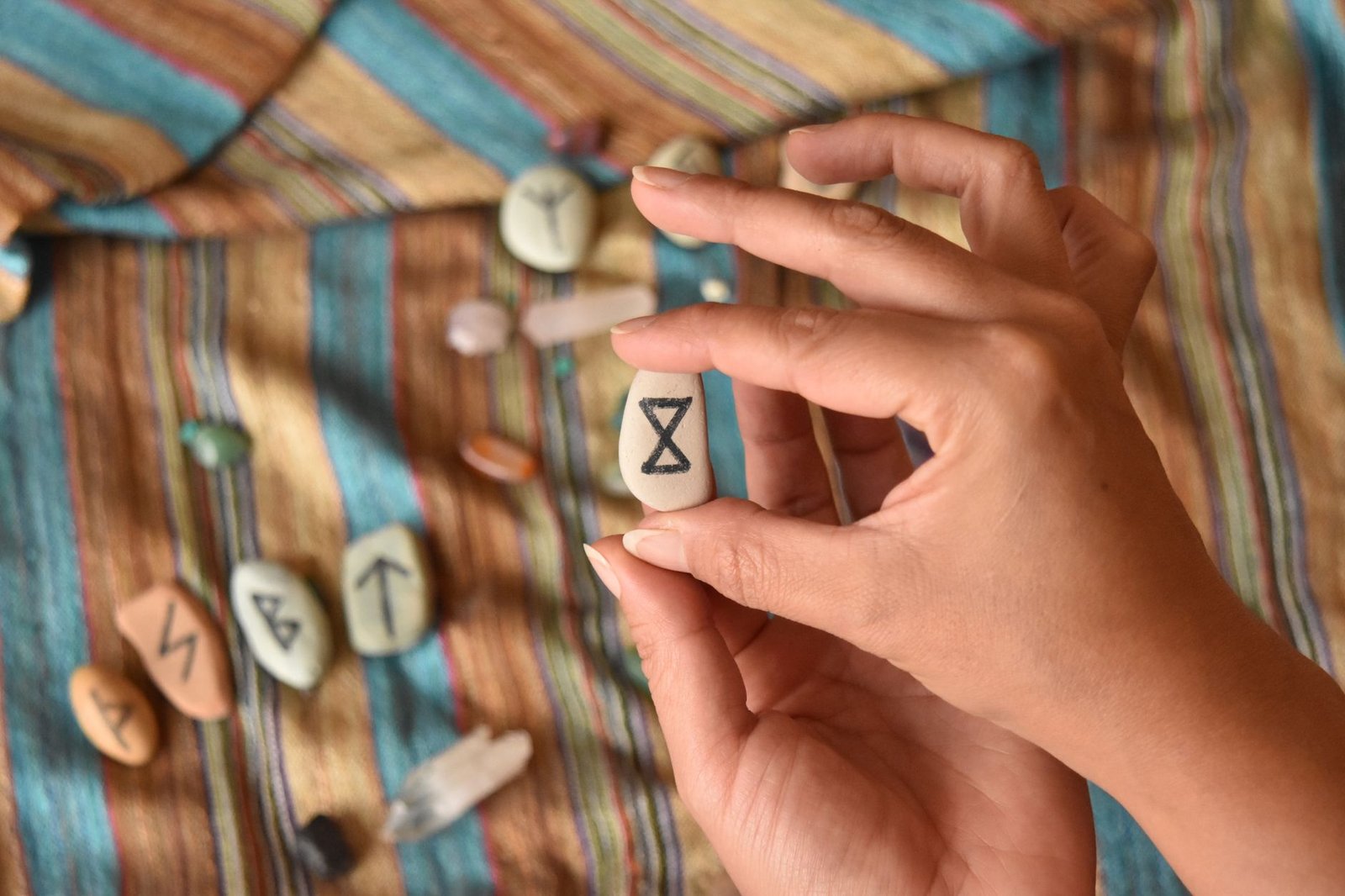
Most beginner rune guides begin with twenty-four symbols and stop there. That is why so many people own a bag of runes and have never actually read with them. A first reading does not require memorising the Elder Futhark. It requires one real question, one honest draw, and a notebook page that records what you saw before you knew what it meant.

This guide covers the practical version: how to set up, which spread to use first, how to read a rune you have not learned yet, and the three habits that make early readings feel like guesswork.
What a first rune reading should actually look like
A rune reading is not a performance. In its simplest historical form it is a single question answered by a marked stone, piece of wood, or bone drawn from a pouch. Everything else — three-rune spreads, nine-rune grids, casting the whole set onto a cloth — is a variation on that core act, and none of them is more “correct” than a single draw.
For a first reading, pick a format that matches how much you can hold in your head at once. A beginner who draws nine runes and cannot interpret four of them learns less than a beginner who draws one and thinks about it for ten minutes.
| Format | Runes used | Time | Best for | Beginner difficulty |
|---|---|---|---|---|
| Single rune draw | 1 | 5–10 min | A daily check-in, or a yes/no framing question | Easiest — start here |
| Three-rune spread | 3 | 15–20 min | Situation, action, likely outcome — the workhorse spread | Easy once you know a dozen runes |
| Five-rune cross | 5 | 25–35 min | Decisions with several moving parts | Moderate — needs a written record |
| Nine-rune grid (three by three) | 9 | 40+ min | Broad life reviews, year-ahead readings | Hard for beginners; easy to over-read |
| Full casting onto a cloth | Whole set | 30–60 min | Narrative and proximity readings, not single questions | Advanced — depends on spatial rules you set yourself |
If you only ever learn one spread, learn the three-rune. It forces you to separate what is happening from what you might do about it, which is the single most useful discipline in any divination practice.
Before you draw: the five-minute setup
Rune readings fail for boring reasons — bad question, no record, phone in hand. Run this checklist first. It takes five minutes and it is the difference between a reading you can learn from and a vague mood you forget by dinner.
- One question, written down. Phrase it as an open question, not a verdict: “What should I understand about this job offer?” rather than “Will I get the job?” Open phrasing gives a rune something to answer.
- A surface that is not your lap. A cloth, a mat, a wooden board. It stops runes rolling and gives the reading a clear boundary — the same reason tarot readers use a spread cloth.
- Your set, checked. Count it. A twenty-four rune Elder Futhark set should have twenty-four. Missing runes produce readings that feel oddly silent.
- Pen and paper, or a notes app already open. Write the rune name, its position, and your first reaction before you look up the meaning. That first reaction is data you cannot recover later.
- Twenty minutes without a screen. Not because runes require ceremony, but because the reading is an act of attention and notifications break it.
- No repeat draws. Decide in advance that you will not re-draw because you dislike the answer. This one rule prevents most of the frustration beginners blame on the runes.
The 24 Elder Futhark runes, grouped the way they are actually taught
The Elder Futhark is divided into three aetts — groups of eight, traditionally named after Freyr, Hagal, and Tyr. Learning them in aetts is far easier than learning twenty-four symbols in a row, because each group has a rough theme: beginnings and resources, then disruption and endurance, then society and inheritance.
| Rune | Name and literal sense | Core keywords | Aett |
|---|---|---|---|
| Fehu | Cattle — movable wealth | Money, resources, earned abundance, circulation | Freyr |
| Uruz | Aurochs — wild ox | Raw strength, health, endurance, untamed energy | Freyr |
| Thurisaz | Thorn, or giant | Conflict, protection, a gate that hurts to cross | Freyr |
| Ansuz | A god — Odin, breath, speech | Messages, advice, insight, a signal worth listening to | Freyr |
| Raidho | Ride, journey | Travel, right order, rhythm, deliberate movement | Freyr |
| Kenaz | Torch, or a sore | Illumination, craft, learning, something brought to light | Freyr |
| Gebo | Gift | Exchange, partnership, generosity, obligation created by a gift | Freyr |
| Wunjo | Joy | Harmony, belonging, relief, things going well | Freyr |
| Hagalaz | Hail | Disruption from outside, sudden change, no negotiation | Hagal |
| Naudiz | Need, constraint | Necessity, scarcity, the pressure that clarifies | Hagal |
| Isa | Ice | Stillness, delay, a pause you cannot force open | Hagal |
| Jera | Year, harvest | Cycles, patience, reward that arrives on its own schedule | Hagal |
| Eihwaz | Yew tree | Endurance, deep roots, protective toughness, transformation | Hagal |
| Perthro | Lot-cup, dice shaker | Chance, the hidden, uncertain outcomes, fate you cannot inspect | Hagal |
| Algiz | Elk, or sedge | Protection, shelter, instinct, warding off what drains you | Hagal |
| Sowilo | Sun | Success, clarity, energy, a decisive bright moment | Hagal |
| Tiwaz | Tyr, the god of law | Justice, integrity, victory through sacrifice, taking a stand | Tyr |
| Berkanan | Birch | Growth, fertility, a fresh start, slow steady flourishing | Tyr |
| Ehwaz | Horse | Movement, partnership, trust between two parties | Tyr |
| Mannaz | Human, person | Self, community, how you are seen, shared effort | Tyr |
| Laguz | Water, lake | Intuition, flow, the subconscious, things felt before they are known | Tyr |
| Ingwaz | Ing, a seed | Gestation, potential, stored energy waiting for its season | Tyr |
| Dagaz | Day, dawn | Breakthrough, awakening, the point where something flips | Tyr |
| Othala | Inherited estate | Home, lineage, values passed down, what you protect for others | Tyr |
One detail worth knowing early: some modern sets include a twenty-fifth “blank rune” or Wyrd rune. It was introduced in the 1980s by Ralph Blum and is not part of the historical Elder Futhark, which has twenty-four. It is harmless as a personal convention, but do not treat it as traditional, and do not buy a set assuming it should be there.
A first reading, step by step
Here is the three-rune spread as a walkthrough. Substitute any question you actually care about — the method stays the same.
- State the question out loud once. “What do I need to understand about this move?” Saying it aloud keeps it stable; silent questions tend to shift halfway through the draw.
- Hold the pouch and mix the runes face down. Thirty seconds is enough. The purpose is not ritual atmosphere, it is to stop you from feeling for a preferred shape through the fabric.
- Draw three, left to right, without looking. Position one is the situation as it stands. Position two is the action or attitude available to you. Position three is the likely direction if nothing changes.
- Turn them over together, then note your gut reaction to each. Write one or two words per rune before consulting any list. This is the part most beginners skip, and it is where the actual skill develops.
- Read each rune in its position, then read the three as a sentence. A rune in position two means something different from the same rune in position three. The sentence matters more than the definitions.
- Close with one action you will take this week. A reading that ends in a concrete intention is remembered; a reading that ends in a feeling is not.
How to read a rune you have not memorised yet
You will not know all twenty-four on day one, and looking them up mid-reading is fine. The trick is to look them up after writing your own impression, then compare the two. Do this consistently and you will be fluent in a few weeks.
When a rune is unfamiliar, work in this order: its literal sense (Fehu is cattle, Othala is inherited land), then its element or material (ice, hail, sun, water), then its story role (Tyr sacrificing a hand for law, Odin trading an eye for knowledge), then the keywords. The literal sense is usually more useful than the abstract keyword, because it gives you something concrete to think with. “Ice” tells you far more about a stalled project than “blockage” does.
Reversed runes, and why you can ignore them at first
Many modern books tell you to read runes as inverted or “merkstave” when they land upside down. It is worth knowing that this is a recent convention, popularised in the twentieth century, not a documented part of historical rune practice — runes were carved into stone and bone where orientation was largely fixed, and older sources read them upright. Modern readers who use merkstave are not wrong, they are simply using a developed system.
For a first reading, choose one approach and stay with it. Either read every rune upright and let position carry the nuance, or use merkstave as “delayed, internal, or resisted.” Do not switch between readings, and do not treat a physically awkward tilt as a message. Consistency is what makes your notes comparable later.
Five beginner mistakes worth avoiding
- Asking a question you have already answered. If you will take the job regardless, the reading is theatre. Pick a question where you are genuinely undecided.
- Drawing again because you disliked the rune. This destroys the record and teaches you nothing. Log the uncomfortable draw — it is usually the one you remember a year later.
- Treating a rune as a prediction with a date on it. Runes describe conditions and pressures. They are poor at timetables, and asking them for one invites invented certainty.
- Reading for other people without asking. A first reading should be about your own situation. Reading a friend’s relationship without their knowledge is both unreliable and rude.
- Buying more sets instead of using the one you have. Ninety-nine percent of beginner progress comes from repeated use of a single set and a notebook, not from materials.
Where runes and tarot overlap — and where they don’t
Runes and tarot get sold as interchangeable, and they are not quite. Tarot is a structured deck of seventy-eight cards with positions, suits, and a dense pictorial tradition; it is excellent at narrative and at emotional nuance because the images do the work. Runes are twenty-four abstract marks with no pictures, which makes them better for blunt framing — a condition, a pressure, a direction — and worse for storytelling. If you want to learn the tarot side properly, our step-by-step beginner guide to learning tarot covers the same discipline with a different tool, and the pendulum work in our pendulum board guide for beginners follows the same one-question, one-answer logic.
Many readers eventually use both: runes to frame a question, tarot to explore it. That combination is not required, but it does solve the most common beginner complaint, which is that a single tool eventually starts giving the same answer to everything.
If your interest in runes is leading you toward paid readings — your own or someone else’s — it is worth knowing what a legitimate online reading looks like before you spend anything. Our comparison of the best online tarot reading sites sets out pricing, refund terms, and the red flags that separate a careful reader from a scripted one.
Frequently asked questions
Do I need all 24 runes for my first reading?
Yes, for a complete Elder Futhark set — but you do not need to know all 24 meanings. Draw from the full set so the reading is not skewed, then look up anything unfamiliar after you have written your own impression. A partial set produces readings that quietly avoid certain themes, which is worse than not knowing a definition.
Can I make my own runes instead of buying a set?
Yes, and many practitioners prefer it. Wooden discs, smooth stones, or even card stock work; what matters is that the 24 marks are clear and that the set is consistent in size so drawing blind is fair. Making your own also forces you to carve or write each rune, which is a faster way to learn them than reading a list.
Which rune should a beginner learn first?
Start with Fehu and Uruz, then move through the first aett in order. Fehu gives you the idea of resources in circulation, and Uruz gives you raw strength and health — between them they cover most everyday questions. The aett order is a teaching sequence, not a ranking, so working through it in order builds vocabulary faster than picking favourites.
Are runes religious, or can anyone use them?
Runes come from a pre-Christian Germanic alphabet with magical and commemorative uses, and some modern practitioners connect them to Norse heathenry. You do not need to follow that religion to use them as a reflective tool, but it is worth being respectful of the source rather than treating the symbols as decoration. If you are using them commercially, say plainly what tradition they come from.
How accurate are rune readings?
Runes are not a forecasting instrument with a measurable hit rate, and anyone promising accuracy percentages is selling something. What a structured reading reliably does is force a clear question, surface what you already suspect, and give you a written record to compare against what actually happened. That record — not the draw itself — is where the value accumulates.
Keep the notebook. In three months it will tell you more about your reading than any book on the Elder Futhark, because it will be about your questions rather than someone else’s definitions.
