

Most people who search for tarot and business are not looking for a fortune teller to run their company. They are staring at a decision that spreadsheets cannot settle: do I take this partnership, do I raise my prices, do I walk away from a client who pays well but drains the team. Tarot does not answer those questions. What it does well is force you to look at the parts of the decision you have been avoiding.
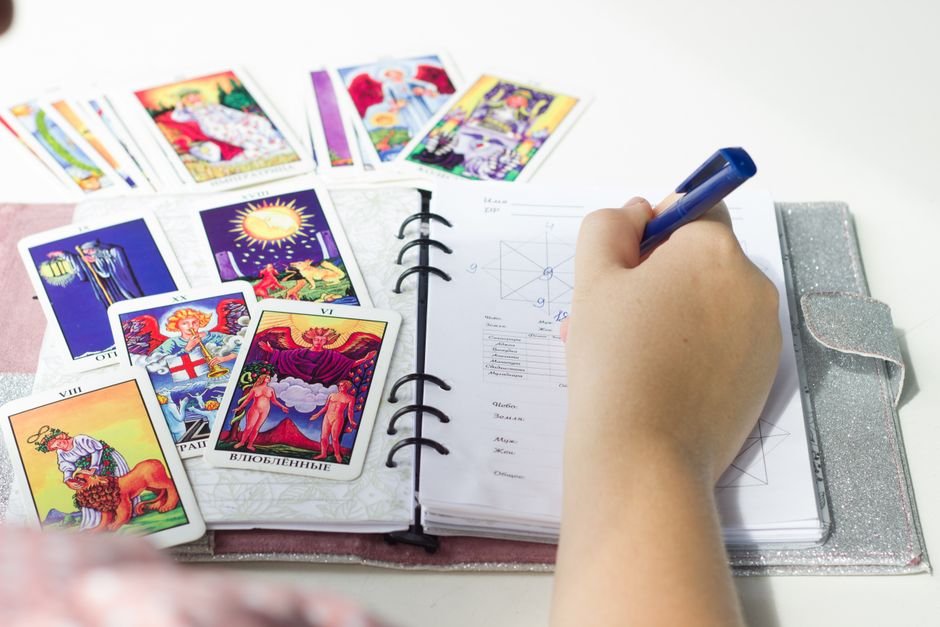
This guide is written for founders, freelancers, and small-business owners who want a structured way to use tarot as a reflection tool in commercial decisions — without outsourcing judgment to a deck of cards. You will get a seven-card spread built specifically for business questions, a script for phrasing questions that produce useful readings instead of vague ones, and a clear list of the places where tarot stops being helpful and starts being expensive.
What tarot can and cannot do for a business decision
The honest framing matters, because the failure mode with tarot in business is not “the cards were wrong.” It is that you feel clarity, act on it, and only later notice you never checked the numbers. Used well, tarot surfaces assumptions, exposes your emotional stake, and gives a team a shared vocabulary for risk. Used badly, it becomes a decision you cannot audit.
| Decision type | Tarot useful? | Primary tool | How to combine them |
|---|---|---|---|
| Pricing change | Marginally | Customer and cost data | Read on your fear of the conversation, not on the price |
| Choosing a business partner | Yes, as a checklist | Reference calls, contract review | Use the spread to name what you have not verified |
| Hiring a senior role | Weakly | Structured interviews, work samples | Never substitute for a reference check |
| Whether to close a product line | Yes, for timing and resistance | P&L, churn data | Read after the numbers, to test your resistance |
| Entering a new market | No | Market research, legal review | Skip tarot here; the uncertainty is external, not internal |
| Renegotiating with a difficult client | Yes | Contract terms, walk-away price | Read on the relationship dynamic, then set terms in writing |
| Founder burnout and direction | Strongly | Rest, honest conversation, therapy | Best use case; tarot is a language for what you already sense |
Notice the pattern: tarot earns its place when the blocker is internal — fear, attachment, avoidance, unclear values. It adds nothing when the blocker is external and knowable. A reading cannot tell you what a competitor will charge next quarter; a market report might.
The seven-card business decision spread
This layout is designed for one decision at a time. Shuffle while holding the question in mind, then lay seven cards in a row and read them left to right as a narrative rather than as seven separate predictions.
| # | Position | Business question it answers |
|---|---|---|
| 1 | The current ground | What is actually true about this situation right now, stripped of my hopes? |
| 2 | The hidden stake | What am I protecting that I have not said out loud? |
| 3 | The real constraint | What limit am I treating as fixed that may not be? |
| 4 | The cost of proceeding | If I say yes, what specifically gets spent — money, time, reputation, energy? |
| 5 | The cost of declining | If I say no, what opportunity or relationship closes? |
| 6 | The overlooked option | What third path have I dismissed too quickly? |
| 7 | The next concrete step | What small, reversible action moves this forward this week? |
Position seven is where most readings go wrong. People want it to say “sign the deal.” A useful card here describes an action you can complete in seven days and undo if it fails — send a revised scope, ask for a trial month, request the missing reference. If the card suggests something irreversible, you have probably read your own impatience into it.
How to phrase a business question
Vague questions produce readings you can interpret any way you like, which feels profound and changes nothing. Before you shuffle, run your question through this checklist.
- One decision only. “Should I raise prices and hire a contractor” is two questions. Split them.
- Name the timeframe. “Over the next two quarters” gives the reading a boundary you can later review.
- Ask about your move, not someone else’s. Not “will they accept my terms” but “what should I understand before I propose these terms.”
- Strip the yes-or-no. Open questions (“what am I not seeing about this partnership”) outperform binary ones.
- Write it down before you shuffle. The written question is your audit trail when you review the reading in ninety days.
- No third-party minds. Reading on a client’s intentions without their participation tends to produce your own anxiety, neatly dressed as insight.
Reading the cards in business language
Traditional card meanings translate into commercial terms without much stretching. The point is not to memorize a new dictionary but to stop reading your business question as if it were a love question.
| Card | Business reading |
|---|---|
| The Emperor | Structure and authority: contracts, org design, who actually decides. Often a prompt to formalize something informal. |
| Four of Pentacles | Hoarding. Cash held too tight, a founder refusing to delegate, a product kept alive past its use. |
| Seven of Pentacles | Patience with a measurable crop. A signal to check whether the investment is genuinely early or simply failing slowly. |
| Five of Swords | A win that costs the relationship. Common in negotiation and partnership readings. |
| The Tower | Forced restructure. Rarely literal ruin; usually an assumption that collapses under contact with a real client. |
| Two of Pentacles | Juggling capacity. A capacity question disguised as a strategy question. |
| The Hermit | Deliberate withdrawal. Useful when a decision needs a week of quiet rather than another meeting. |
| Ace of Wands | A start with energy but no plan. Pair it with position four or it becomes a distraction. |
A thirty-minute session, start to finish
- Minutes 0–5: write the decision in one sentence. Include the timeframe and the amount at stake. If you cannot state the amount at stake, you are not ready to read.
- Minutes 5–10: put the facts on one page. Revenue, cost, hours, the worst realistic outcome. Tarot goes second, never first.
- Minutes 10–15: shuffle and lay the seven cards. Note the first reaction to each card before you interpret it. That reaction is data about you.
- Minutes 15–25: write two sentences per position. No card gets more than two sentences; this prevents the reading from becoming a novel you write to justify a choice you already made.
- Minutes 25–30: choose one reversible action. Put it in your calendar with a review date. The review date is the part that makes this a business practice rather than a ritual.
- Ninety days later: reread the notes. Score what you got right and what you projected. This is how the practice improves instead of becoming superstition.
If you are new to the deck itself, the mechanics of shuffling, spreads, and reversals are worth learning properly before applying them to commercial stakes — our step-by-step beginner guide to learning tarot covers that foundation, and the five-card career spread is a lighter option if seven cards feels like too much structure for a first pass.
Where tarot quietly costs you money
- Substituting a reading for due diligence. No card replaces a reference call, a contract clause, or a look at churn.
- Reading repeatedly until you get the answer you want. Three readings on the same decision in a week means you are negotiating with yourself, not consulting anything.
- Letting a paid reader make the call. A reader can reflect your situation back with skill; they cannot carry the consequences of your decision.
- Reading on external unknowns. Competitor pricing, regulation, and platform policy are research questions.
- Treating a good reading as permission to skip the conversation. The hardest message in a spread is usually the meeting you have been avoiding booking.
Red flags when someone sells tarot as business advice
A growing number of online readers market themselves specifically to entrepreneurs. Some are thoughtful; some are selling certainty. Watch for these signals before you pay.
- Guarantees about revenue, funding, or specific outcomes.
- Pressure to decide within the session, with a discount that expires when you hang up.
- Requests for your bank details, tax IDs, or access to business accounts.
- Claims of removing a curse, block, or “bad business energy” for an escalating fee.
- Refusal to state a price per minute before the reading starts.
- Insistence that you not discuss the reading with your co-founder or accountant.
If you want to compare platforms before booking, our review of the best online tarot reading sites covers pricing structures and refund policies side by side. That comparison is a more reliable starting point than any single reader’s testimonial.
Frequently asked questions
Is it appropriate to use tarot for business decisions at all?
Yes, as a structured reflection tool with a review loop. It is not appropriate as the sole basis for a decision with material financial or legal consequences. Read after you have the facts, not instead of getting them, and keep a written record so you can audit the reading later.
Which spread works best for a pricing or negotiation question?
The seven-card layout in this guide works well, but for negotiation specifically, position four and five — the cost of proceeding and the cost of declining — carry most of the value. Add a written walk-away number before you shuffle, and do not change it after the reading.
Can tarot predict whether a partnership will succeed?
No. It can surface what you have not verified about the partner, and it can make your own reservations harder to ignore. Whether the partnership succeeds depends on alignment of incentives, contract terms, and execution — all of which are checkable in the present, not predictable from a deck.
How often should I read on the same business decision?
Once, then again only after something material changes — a new offer, a signed term sheet, a lost client. Repeated readings on an unchanged situation mostly measure your anxiety, and anxiety is a poor advisor when the stakes are commercial.
Do I need a professional reader for a business spread?
Not necessarily. Most of the value comes from the structure: a specific question, a fixed layout, written notes, and a review date. A skilled reader can help you notice what you skipped, but the person with the most context about your business is you.
The short version
Tarot earns a place in business decisions when it is used as a disciplined reflection exercise: one decision, seven positions, written answers, one reversible action, a review date ninety days out. It loses that place the moment it stands in for diligence, or when someone sells it to you as a guarantee. The cards will not tell you what to do with your company. They are good at showing you which conversation you have been postponing — and that conversation is usually the decision.
