

If you have ever watched someone hold a small dangling crystal over a flat board and watched it swing toward “yes” or “no,” you already know why pendulum boards are so popular. They are one of the simplest divination tools to learn, they cost very little, and they give you a clear, structured way to practice listening to your own intuition. This guide walks you through everything a first-timer needs: what a pendulum board actually is, how to prepare yourself and your tools, how to ask questions that get usable answers, and the mistakes almost every beginner makes at least once.
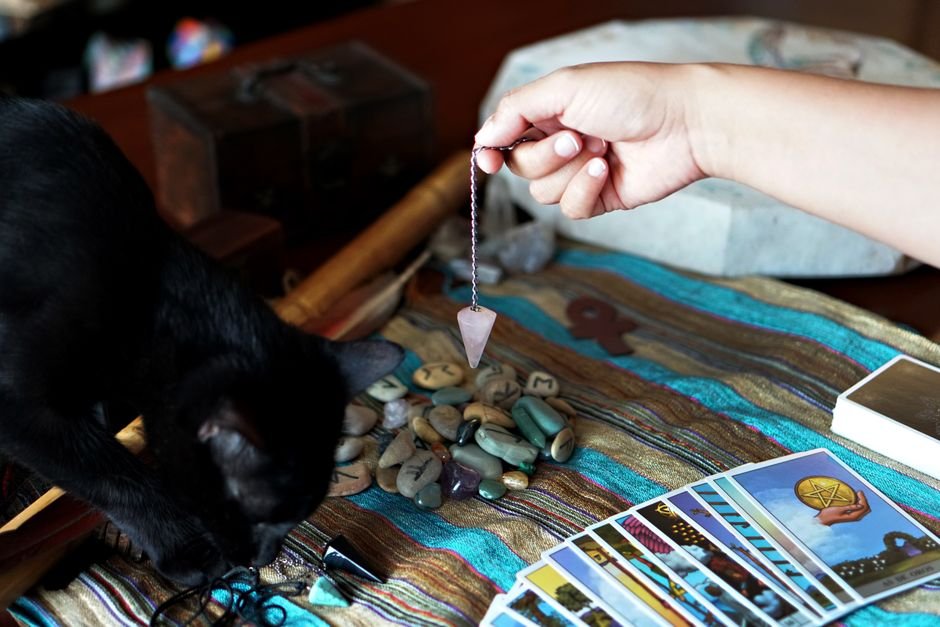
One honest note before we start: a pendulum is best understood as a tool for reflection and self-exploration, not a crystal ball. The subtle muscle movements that drive the swing — often called the ideomotor response — are believed by many practitioners to carry intuitive signals from your own deeper mind. Treat your answers as prompts for thought and entertainment, never as a replacement for professional medical, financial, or legal advice. With that mindset, you will get far more out of the practice.
What Is a Pendulum Board?
A pendulum board (sometimes called a dowsing board) is a flat surface printed with words, letters, numbers, or symbols around its edge or in sections. Common layouts include simple Yes / No / Maybe boards, alphabet boards for spelling out longer answers, and boards with numbered scales from 1 to 10. You hold a pendulum — a weighted object such as a crystal, metal point, or wooden charm suspended from a chain or cord — above the center of the board, keep your hand still, and observe which section the pendulum swings toward.
The board does the “translation” for you. Instead of guessing what a random circle or wiggle means, you get predefined zones: yes, no, maybe, or letters that spell out words. For beginners, that structure is the biggest advantage. It removes ambiguity while you are still learning how your pendulum moves.
Choosing Your First Pendulum and Board
You do not need anything expensive. Any weighted object on a chain works — many people start with a simple amethyst, clear quartz, or brass pendulum. What matters most is that it feels comfortable in your hand and swings freely without sticking. A teardrop or pointed shape makes direction easier to read than a round bead.
For your board, start simple. A Yes/No/Maybe layout is the best training ground. Once your yes and no swings feel consistent, you can graduate to alphabet or numbered boards. Some practitioners use a printed chart or even a hand-drawn circle on paper — the tool matters far less than the consistency of your practice.
How to Prepare Before Your First Session
1. Cleanse your pendulum
Most readers like to “reset” a new pendulum before its first use. Popular methods include placing it in moonlight overnight, resting it on a bed of salt for a few hours, smudging it with smoke, or simply holding it under cool running water (only if the material is water-safe — avoid this for soft stones like selenite). The cleansing step is largely symbolic, but ritual helps shift your mind into a focused state, and that focus is what actually improves your readings.
2. Pick a quiet space
Sit at a table where your elbow can rest comfortably. Turn off notifications, take a few slow breaths, and give yourself ten to fifteen minutes of uninterrupted time. A steady hand and a calm mind make your pendulum’s movements far easier to read.
3. Establish your yes and no signals
This is the single most important prep step. Every pendulum moves a little differently, so never assume “forward-back means yes.” Program your own signals like this:
- Hold the pendulum by the chain or cord, about 3 to 5 inches above the center of the board, keeping your hand as still as possible.
- Say or think clearly: “Show me yes.” Watch which way it swings — toward “yes,” in a circle, front to back. Whatever it does, that is your yes signal.
- Say: “Show me no.” Note the movement. It is usually a different direction.
- Repeat each a few times until the movements feel consistent. Some readers also establish a “no answer / unclear” signal, such as a chaotic or sideways shake.
Write your signals down. When you know exactly what your yes looks like, interpreting a reading becomes straightforward instead of guesswork.
How to Ask Questions That Get Clear Answers
Pendulums respond best to questions that can be answered within the board’s layout. Vague, multi-part, or emotionally loaded questions tend to produce confusing swings. Follow these guidelines:
- Ask one question at a time. “Should I take the new job and move cities?” is really two questions. Split it up.
- Phrase things so yes or no makes sense. Instead of “What should I do about my career?” ask “Is now a good time to change my career direction?”
- Stay neutral. If you are desperate for a specific answer, your body can influence the swing. It helps to close your eyes while asking, then open them to observe the response.
- Rephrase and cross-check. If you get an unexpected answer, ask the same question in different words. A genuine signal stays consistent; a random twitch usually does not.
- Rest when your arm tires. A shaking hand muddies everything. Short sessions of five to ten minutes produce better readings than marathon ones.
Good starter questions for practice: “Did I sleep well last night?”, “Is it a good day to focus on rest?”, “Is there something I should pay attention to today?” Questions you already know the answer to are excellent calibration exercises — if your pendulum says yes when the sky is clearly blue, you know your signals need more work.
Interpreting Your Pendulum Board Answers
Reading the board is simple once your signals are set. On a Yes/No board, note which zone the pendulum gravitates toward and how decisively it gets there. A strong, steady, wide swing toward “yes” reads as a clear affirmative. A weak, hesitant, or drifting movement often means “unclear” — which usually signals a poorly phrased question, a tired arm, or genuine ambivalence on the topic.
On an alphabet board, watch the pendulum’s path letter by letter and write them down as they come. Be patient; spelling takes practice, and early attempts may produce gibberish. Many readers stick with Yes/No boards for months before trying letters, and that is completely fine.
However you interpret the result, remember what the pendulum is for. Use each answer as a journaling prompt: “Why might my intuition be pointing to rest today?” or “What am I really hoping the answer will be?” The reflection is where the real value lives — not in treating the swing as an unchangeable verdict about your future.
Pendulum Board vs. Freehand Pendulum vs. Tarot for Yes/No Questions
Beginners often wonder whether they even need a board, or whether tarot would serve them better. Here is an honest comparison of the three most common approaches:
| Feature | Pendulum Board | Freehand Pendulum | Tarot Cards |
|---|---|---|---|
| Learning curve | Very gentle — predefined zones remove guesswork | Moderate — you must interpret raw swings yourself | Steeper — card meanings take months to learn |
| Answer clarity for yes/no questions | High — direct “yes” and “no” zones | Medium — depends on your established signals | Medium — requires reading card combinations |
| Depth of answer | Low to medium — best for simple questions | Low to medium — same limits as a board | High — cards offer rich context and nuance |
| Equipment needed | Pendulum plus a board | Pendulum only | A tarot deck |
| Best for | Beginners and quick daily check-ins | Practiced users who want minimal tools | Deeper reflection and storytelling readings |
If you find yourself drawn to the richer, more layered answers that cards provide, our guide to the tarot vs oracle cards difference will help you pick the right deck to learn alongside your pendulum. Many readers happily use both — a quick pendulum check for simple questions, and a card pull for anything that deserves deeper exploration.
Common Beginner Mistakes to Avoid
- Asking the same question repeatedly. If you keep re-asking until you get the answer you want, the pendulum is just echoing your hopes. One question, one reading, then move on.
- Skipping the calibration step. Assuming forward means yes without testing leads to misread answers. Always establish your signals first.
- Using it for serious decisions. Do not consult a pendulum about medical symptoms, investments, legal matters, or other people’s private lives. These deserve professionals and direct conversation.
- Reading into every wobble. Hands are never perfectly still. Small twitches and drifts are normal — only a clear, sustained movement toward a zone counts as an answer.
- Practicing while exhausted or upset. Strong emotions and fatigue make interpretation unreliable. Come back when you are centered.
- Treating it as fortune-telling. A pendulum reflects your present inner state and intuition. It does not lock in the future, and any reader who promises guaranteed predictions is overstating what this tool can do.
Caring for and Cleansing Your Pendulum
A little routine maintenance keeps your practice feeling fresh. Between sessions, store your pendulum in a small pouch or box so the chain does not tangle, and keep it somewhere you associate with calm rather than tossed in a junk drawer. Many readers cleanse their pendulum whenever it feels “heavy” or after an emotionally intense session — moonlight, sound (a bell or singing bowl), or smoke all work well depending on the material.
Physically, wipe crystal and metal pendulums with a soft dry cloth. Check the chain and clasp occasionally; a loose connector can cause erratic swings that have nothing to do with intuition. If a pendulum consistently frustrates you no matter what you try, it is perfectly fine to set it aside and try a different shape or weight. Compatibility matters more than tradition.
Your First Week Practice Plan
- Day 1: Cleanse your pendulum, calibrate your yes/no/unclear signals, and write them down.
- Day 2–3: Ask three questions you already know the answer to and note the accuracy of your swings.
- Day 4–5: Move to open-ended daily check-ins: “Is today a good day to focus on X?” Journal each answer and how you felt about it.
- Day 6–7: Review your journal. Look for patterns — did certain question types produce clearer swings? Adjust your phrasing accordingly.
By the end of a week of short daily sessions, most beginners can read their own pendulum’s signals with reasonable confidence — and, more importantly, they have started a genuine dialogue with their own intuition.
Frequently Asked Questions
Does a pendulum board really work?
It depends on what you mean by “work.” The pendulum’s movement comes from tiny, involuntary muscle responses in your hand, which many practitioners believe carry intuitive information from your subconscious. As a tool for reflection, self-inquiry, and entertainment, it works well. It is not a scientific instrument and cannot reliably predict future events or replace professional advice.
Can I use a necklace as a pendulum?
Yes. Any weighted object on a chain or cord will function as a pendulum — a ring or small pendant on a necklace is a classic beginner setup. Just make sure the weight is centered and swings freely, and calibrate your yes/no signals exactly as you would with a store-bought pendulum.
Why does my pendulum give unclear or no answers?
The most common causes are an ambiguous question, a tired or tense arm, strong emotions pulling the answer in one direction, or questions the pendulum “cannot” answer well (such as matters involving other people’s choices). Take a break, rephrase the question into a simple yes-or-no form, and try again. Sometimes “unclear” is genuinely the most honest answer available.
How often should I cleanse my pendulum board and pendulum?
There is no fixed rule. Many readers cleanse their tools monthly, after intense sessions, or whenever the practice starts feeling stale. What matters is that the ritual marks a fresh start for your focus. If your board is paper or card, avoid water and use sound or moonlight cleansing instead.
Is a pendulum board suitable for complete beginners to divination?
Absolutely — it is arguably the friendliest entry point there is. There are no complex card meanings to memorize, and the board’s predefined zones give you immediate, structured feedback. If you enjoy it and want to expand later, comparing the best online tarot reading sites can also connect you with experienced readers whose techniques are worth studying as you develop your own practice.
