
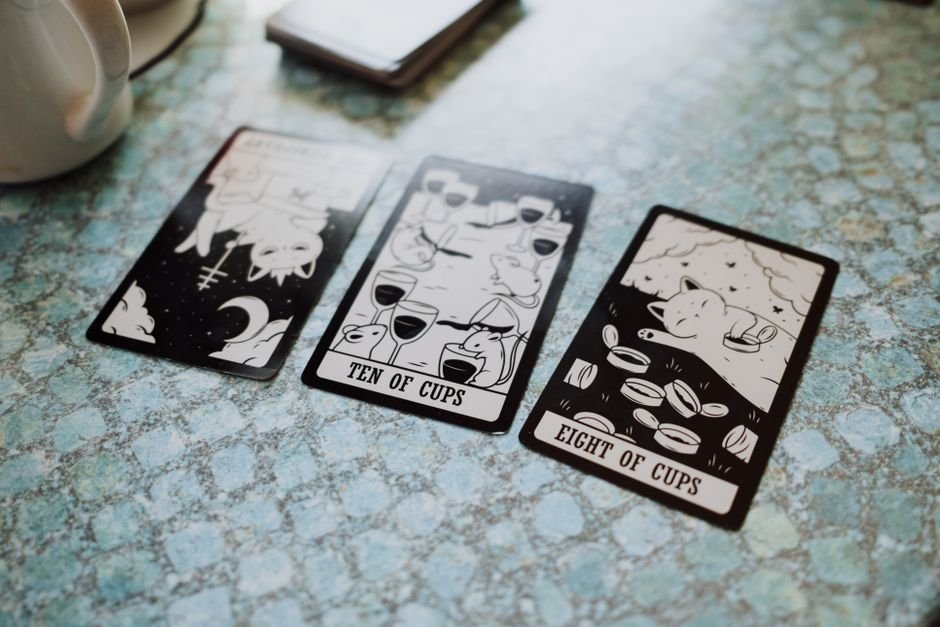
What Is a Three Card Tarot Spread?
The three card spread is the first layout most tarot readers learn, and for good reason. It uses a small number of cards, it answers a clear question, and it does not require you to memorize complicated position systems before you can start reading. If you have just learned the card meanings and you are wondering what to do next, the three card spread is the natural bridge between studying the deck and giving real readings.
A three card spread works by assigning a specific role to each of the three positions. The cards do not float in space; each one answers a part of your question. Once you draw three cards, you read them left to right as a story: the first position sets the scene, the second shows the core of the matter, and the third points to where things are heading. This storytelling structure is what makes the spread so effective for beginners — it gives you a narrative frame even when the individual card meanings feel overwhelming.
Five Three Card Layouts Compared
There is no single “correct” three card spread. The layout you choose should match the question you are asking. Here are five of the most widely used three card layouts, side by side:
| Layout | Card 1 | Card 2 | Card 3 | Best For |
|---|---|---|---|---|
| Past / Present / Future | Influences behind you | Where things stand now | Where things are heading | General timing questions and “what happens next” |
| Situation / Action / Outcome | The core problem | What you should do | Likely result of that action | Decisions where you can still change the result |
| Mind / Body / Spirit | Your thoughts and beliefs | Physical state and habits | Deeper needs and values | Self-check-ins and reflection |
| Problem / Cause / Solution | The visible issue | The hidden root | The way forward | Something that keeps going wrong |
| You / Them / The Relationship | Your side of the dynamic | Their side of the dynamic | The energy between you | Relationship and friendship questions |
As a beginner, start with Past / Present / Future for general questions, and switch to Situation / Action / Outcome whenever you are facing a real decision. The other three layouts are useful variations you can grow into over your first few months of practice.
How to Do a Three Card Spread: A Beginner’s Checklist
Use this checklist every time you practice. It takes less than twenty minutes and it builds the habits that professional readers rely on:
- Write your question down. Open-ended questions (“What do I need to know about my new job?”) produce clearer readings than yes/no questions.
- Choose one layout and say the positions out loud. For example: “Card one is the past, card two is the present, card three is the future.”
- Shuffle with the question in mind. Shuffle until it feels natural to stop — there is no required number of shuffles.
- Cut the deck and draw three cards, laying them left to right in order.
- Name each card before interpreting it. Say the card’s name, its core meaning, and whether it is upright or reversed.
- Read the three cards as one sentence before you dig into details. For example: “Because I avoided a hard conversation in the past, I now feel stuck, and avoiding it further leads to more frustration.”
- Take a short note of the cards and your one-sentence summary. Reviewing old notes is the fastest way to see your own reading patterns.
That final step matters more than beginners expect. A reading journal turns random practice into trackable experience, and it is one of the clearest signs of a reader who is building genuine skill rather than guessing.
A Worked Example: Situation / Action / Outcome
Suppose your question is: “What should I do about the tension with my roommate?” You draw three cards and get the Five of Wands, the Two of Cups, and the Eight of Swords.
Situation — Five of Wands: competing egos and friction. This confirms the tension is real and currently active — small clashes over chores, noise, and shared space.
Action — Two of Cups: a card of partnership and mutual goodwill. The advice is to repair the relationship directly: a calm conversation, an honest reset, perhaps a shared agreement written down.
Outcome — Eight of Swords: feeling trapped. Read in context, this warns that if you keep avoiding the conversation, the situation hardens into a trap where both of you feel stuck. It is a consequence card, not a life sentence — which is exactly why the Action position matters.
Notice what happened there: the three cards formed an argument, and the layout gave that argument a direction. This is the core skill of spread reading — connecting cards into a story — and the three card spread is the smallest possible practice ground for it.
Common Beginner Mistakes to Avoid
- Interpreting each card in isolation. If your three cards never connect, the reading is just three definitions read aloud. Always ask how card two modifies card one, and how card three responds to both.
- Switching layouts mid-reading. If a card looks “bad” in position two, do not quietly decide it belongs in position three. Changing the rules to get a friendlier answer is the fastest way to lose trust in your own readings.
- Asking three questions in one draw. One draw answers one question. If you ask about love, money, and your career in a single three card spread, no position has a clear job.
- Treating the future card as fixed. In spreads with an outcome position, the third card describes where the current path leads — not a prophecy. Your actions in the present are exactly what the reading is designed to inform.
- Pulling endless clarifier cards. If the reading is unclear, it is usually a vague question, not a missing card. Re-ask the question tomorrow with sharper wording.
Frequently Asked Questions
Is a three card spread accurate for beginners?
Accuracy depends far more on the clarity of your question and your honesty in interpretation than on spread size. A three card spread is actually easier to read accurately as a beginner because there are fewer cards to blur together. Many professional readers still use it daily for quick checks.
Should I use reversed cards in a three card spread?
It is a personal choice. If reversals overwhelm you, read every card upright for your first month and add reversals later. Consistency matters more than completeness — pick one approach per reading and stick with it.
Can I ask a yes or no question with three cards?
You can, but it is not the spread’s strength. Three card layouts are built for narrative questions. If you want a yes or no answer, a dedicated one card or three card yes/no method works better — but expect a less nuanced answer.
How often should I do a three card spread?
A daily three card draw in the morning (for example, Mind / Body / Spirit) is a classic practice habit. It builds fluency with card meanings in context, which is exactly what makes longer spreads readable later.
What if all three cards are “bad” cards?
Do not panic and do not re-draw. Difficult cards describe energy and pressure, not fixed outcomes. Read the sequence: where the difficulty came from, where it lives now, and what direction eases it. That third card is almost always the most useful one.
Final Thoughts
The three card spread rewards simplicity. Choose a layout that matches your question, write the question down, and force yourself to read the three cards as one connected story. Twenty minutes of focused practice a day will do more for your reading skill than memorizing every card in every position.
Once your daily practice feels comfortable, you may want real feedback on your interpretations. A practical next step is to compare your own reading against a professional one: our roundup of the best online tarot reading sites in 2026 covers the platforms worth trying, with free-minute offers that make a first professional reading inexpensive. Treat it as a calibration exercise — see how an experienced reader frames the same question, then bring that structure back to your own three card practice.
